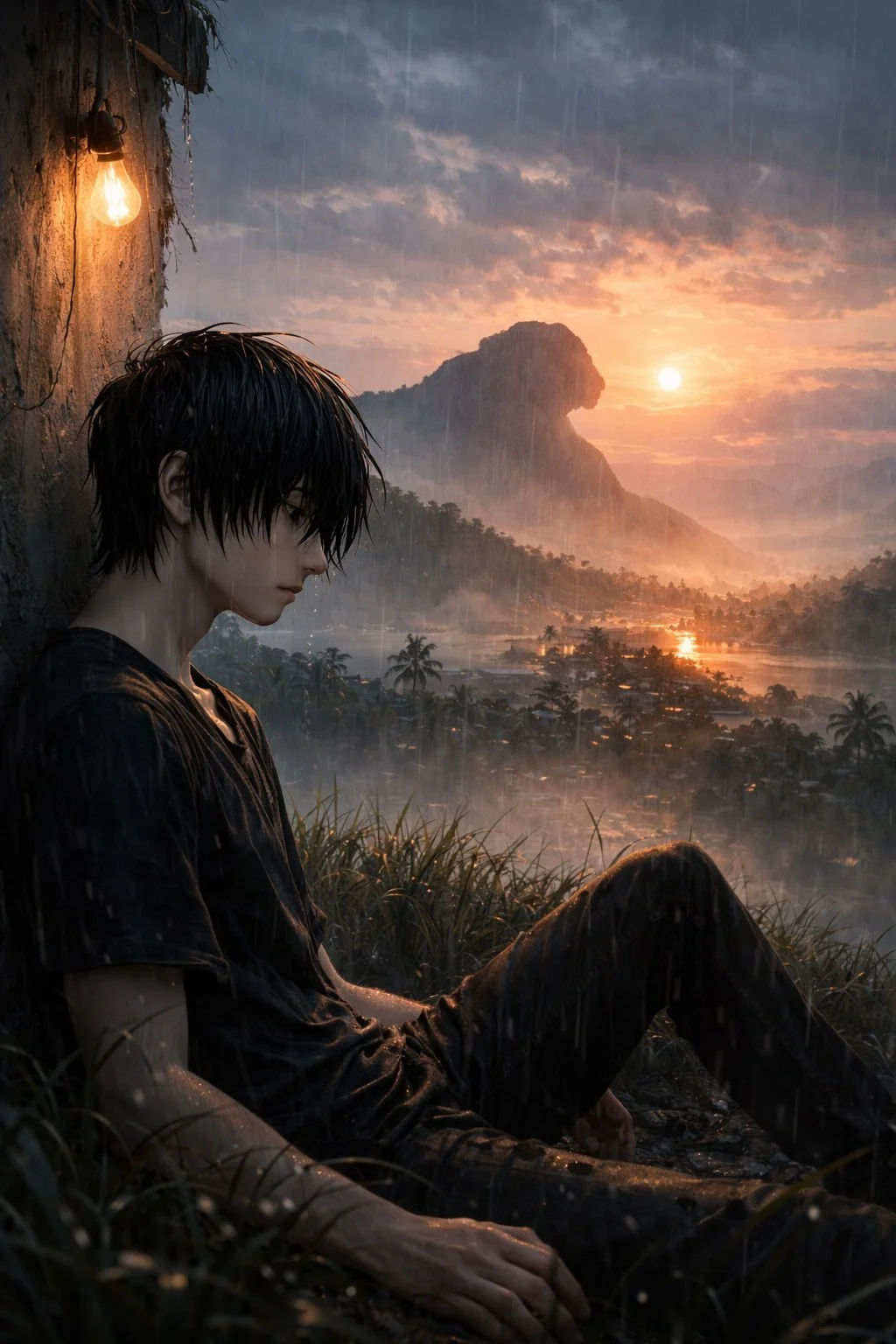
circa 2008, first glimpse, recast. feel free to notice the palpable desperation in my twenty year old psyche. also, my sincerest apologies for the pseudocosmology/spirituality conveyed here. lol...
I’m here. It’s sometime after midnight, and raining, and I’m sitting here against a broken white wall, under this pendulous light that flickers precariously on and off from above me. There’s grass all around me, and I’m pretty sure something is crawling up my left thigh. I’m incapable of swatting it away. I can’t lift my hand, or my arm, or my body off of these broken grounds.
The view from here is immaculate. Right now, from my place here on this quiet landscape, I can see the sun rising, calmly, confidently. It does that everyday, it seems. Throughout these valleys, over dehydrated bodies and dilapidated street corners, in the least favorable of places and times, it rises again.
I read somewhere that when the Portuguese colonists came here long ago, they saw from their ships in the distance a mountain side in the shape of a lion, and somewhere beyond them, in those exact moments, a loud thunder sounded from the sky, imitating the roar of a lion. The colonists named the land where they disembarked Sierra Leone, which means Lion Mountain in Portuguese.
No one ever told them that that would be meaningless, though. That the land wouldn’t be impacted by the poetic auguries or invocations of lofty visions and grand desires. It would become corrupted by the humans that resided here, affected by our maligning influence, destroyed with the passage of time and war. Meaningless.
I also read on a random page of a Google search that the sulfuric and nitric acids in rainfall in the developing world can be bad for your hair, rendering it dry and thin. That’s why I’m sitting under this tin awning while I write to you. I wouldn’t be out here otherwise. I value my hair too much. I need to stay young forever.
I have something I need to do now, while my voice is still young and unjaded and clear of the influence of my peers and conventional contexts. My isolation from them is empowering. They would probably have me know that this effort is futile—that I am vain to consider writing this from these embryonic confines. I am cognizant that I run certain risks in pursuing this. So be it.
I’ve been thinking a lot recently about success and the heroes that attain it, the stuff of fairytales and Disney movies, with all their concomitant glories. I’ve been thinking about reflection and storytelling, too. Typically, when we think of the memoir genre we evoke antiquated genarians commenting retrospectively on adversities far off, past, distant, while they are tucked away in ivory towers, comfortable, cautiously confident in their victories over other men and war and life. Their pains are basically past them. They are older. They’re definitely not twenty-one years old. They would never dream of beginning to tell their stories while in the midst of their suffering, while fallen.
But I have become repulsed by the tales of old men, paperbound and mass-printed and lovingly arranged on the tables that line the entrances of Barnes & Noble for passerby to see. These are the contrived narratives of the old. They like to revisit regrets. Failed agendas and banal life rituals--trivial successes revisited, varnished over, repainted. They're desperately searching for a final pretext to let themselves believe that their lives here have been worthwhile, so that maybe this way they can live on, matter, perhaps even have peace. The ostensibly innocuous enterprise of internal retrospection becomes an end in and of itself, an ego-driven attempt to cast a pathetic life in a wonderful light. And so the attentive, reverent, pedantic masses will listen and watch in peaceful slumber as the old ones rewrite history as best they can, quietly, volubly, sometimes beautifully, defining the various archetypal patterns of temporal life, fucking up the mental constructs of the young, the perennial definitions and concepts and premises that comprise our collective social programming, right before our eyes. Whether you lack the ability to comprehend this or not, that programming will define, and always has defined, our beliefs about what is possible in the world, necessarily conditioning our ability to create a majestic, beautiful life--the kind we have dreamt of and read about in mystic lore.
Bill Clinton won the Rhodes Scholarship, became a president of a nation on the earth, and balanced a national budget during his term in office. Follow this and other successful archetypal patterns. This is the unrelenting cry of what Anna Quindlen calls the seductive "Greek chorus that thinks it knows the parameters of a happy life, when all it knows is homogenization of human experience." Kids aren't transcending these retarded archetypes because they probably aren't aware that infinitely better ones exist out there, in distant lands, along holy rivers, in sacred mountains, and on ultramundane planets far far away from the sun.
Why haven't you heard of Babaji, an avatar who has lived for over five thousand years in the crags of the Himalayas, ascended into the quiet sky, in an ageless body that appears no older than that of a youth of twenty-four years-old, his biological template unsubject to the rules of the universal economy? Why isn't he on a pedestal for the world over? And why is the alternative the former CEO of Microsoft? This seems like a devastatingly high opportunity cost to me. And I'm just scratching the surface, I could elaborate. Everything is so eloquently, masterfully awry. Seriously, I couldn't have done it better myself, congratulations to you all, men and women behind the scenes, your shenanigans are ruthlessly sophisticated, but the word awakens, provokes, forcibly pries open the eyes of men. Spirituality and inward introspection are often dismissed by the elite of the world as a broadscale concession game, a fallback for failed human beings who cannot make it in the 'real world' (thank you for that tired cliché), and require inner solace as they make headway unto death. I understand that for many of you that's the implication that's surfacing, right now, from somewhere deep and atavistic in your biochemistry, even if you're trying hard to suppress it and politely smile and say that you understand me, just moments before going back to your Goldman Sachs internship application essay. It's socially prudent and acceptable and refined and symptomatic of cultivation to be tolerant and respectful of differences. So you should keep on doing just that, lest you draw condemning appraisals from your immediate social context. The most malevolence is often found in the most mannered and refined human beings. Please cuss and throw dirt in my eye instead. (And don't worry, refined people are supposed to swear, who even invented that rule, anyway? ;)
I'm afraid you've missed the point. Let us be clear. It's not that the precocious are unable to make it in the world. It's that they're trying desperately to free it--to free you. It's that you're too fearful to consummately understand the truth, proactively pursuit it, obsessionally delimit its peripheral boundaries, its gradiences carrying over into sublimity. And it is the truth that sets you free--you've heard this before, so why are you so slow? Ours is the higher standard. It's not that we're naive. It's that you're naive. How did it come to pass that the materialists, egoists, bureaucrats, dogmatists, religionists, scientists, and politicians have hijacked the word 'naive' in this perilous hour, right when the pure of heart need it to ascribe to the others the most? How did it come to pass that the worst of every kind of human archetype malevolently wields the word as a weapon against the sane? People like Sam Harris are not bad (I guess, what would that even mean?)--he's just an idiot, but I mean 'idiot' in a way you've probably never heard, understood the word before. 'Smart' (v. 800, m. 800, w. 800) versus 'stupid' (v. 510, m. 540, w. 490) is another useless false dichotomy, an irrational distraction, an Ouroboros condemned to consume itself along with all those who judiciously subscribe to it, denying us purity and peace and truth forever. Smart versus stupid isn't what we should be talking about. The operative word instead should be 'deluded'. Are people deluded or not? Do they see the obvious or not? Are they able to see their own bullshit for what it is or not? Are they on fluoridated tap water or not? I want to see Sam Harris off of fluoride for seven weeks. Seriously, I really do. (Fiji Water, that luxury water brand endorsed by the stars, contains sodium fluoride, by the way. Fluoride calcifies the pineal gland, our delicate spiritual third eye, promoting docility in populations, rendering the masses spiritually weak, thoroughly malleable on every landscape. Stalin impregnated the waters at his gulags with fluoride in liberal doses, once upon a time. Do I have your attention now?) Isn't it supremely interesting that everyone who stops undermining their pineal gland with insanely bad food and water and air seems to land on the same general premises, assumptions about the way the universe works? The Mayans, the Indus Valley civilization, the Chinese, the Greeks: any apparent philosophical differences among them are semantic, attributable to historical error--at the highest levels there aren't really any real, conceptual differences, despite what you've been told. The perennial axial sages (Confucius, Buddha, Lǎo.zǐ 老子, Socrates--and these are just the ones we know about!) came to be in one, single era, simultaneously, breathed into life by a source field that permeated the world over in circa 500 B.C. So I'm talking about a return to common sense of the highest and most refined order. Make no mistake, there are those who are deluded and there are those who are not. Recall that everyone called Galileo insane when he shouted from the rooftops that the earth revolved around the sun, not the other way around. He paid for that epiphany with his life (and his soul, apparently--ouch, excommunication's a bitch). But he was just vocalizing something retardedly trivial by today's standards, right? The words 'smart' and 'stupid', in the way we've been using them, are useless--fool's errands to the nth degree. Harris' prose is extremely lucid, polite, even poetic at times. He has an impressive vocabulary and socially valued academic credentials. But these don't mean anything to those of us who can see the ethereal moon in the night sky, while he's still trying to exhume the decaying carcasses in the valley of the dead, no matter how competent his shovel might be. Being the best cow doesn't make you a cowboy. He will always be just another guy who got lost in a démodé scientific paradigm and an unworkable worldview, victim of his own brand of dogma and poverty consciousness. This extends to Richard Dawkins, as well, who tries desperately to defend falsehood under the guise of incomplete and awry science and a masterful vocabulary. It helps that he's secured a nice gig at Oxford, though. Whatever, that world is crumbling now under the weight of a new earth being borne.
There are those among us who understand that we emanate out of the cosmic ocean, that consciousness is on an undying repeat loop, and each time we're reset we forget our experiences in all the iterations before. They've caught on--you haven't yet. Some people are faster than others on the evolutionary arc, there's no doubt about that. The problem arises when the latter, thoroughly caught in fear, pass off total vacuity and insanity as truth under the guise of intellectualism, science, and 'reason', to bring down anything that constitutes a threat to their worldview. They are destroying the world over, more than any religious fundamentalists ever could. They would unknowingly tear the heart out of the human condition.
I understand you need materialism to quell your constant suffering, the perpetual and heavy insinuation deep within your mind that you are not enough, that you require 'more', and yet you fail at addressing this satisfactorily every time. So it's not that the evolved among us have given up on being 'successful'. It's that you're not successful enough. Your standards are too low. You're not elite enough. Almost dying because of heart complications, requiring quadruple heart bypass surgery to stay alive, is not elite. It's just pathetic. And yet, those to whom society ascribes the adjective 'elite' are notorious for devastating their anatomies to ungodly degrees in their quests to realize vacuous, often deeply harmful, ambitions. These are not elite. They never were.
We, the children of the earth, will forever fail at life if we continue to rely on the broken, lying premises of the few men and women preselected to be propped up on the altars of the world, stationed there on purpose to tell us the way of things. They presume--they will presume--to tell us how 'success' came to be once upon a time. But here's the secret they never get around to telling us: that anything historicized is a lie. Truth, cyclically, forever, dogmatically, becomes obscured by fiction and ego and false dichotomies and Hegelian dialectics. The only way we save our life is by losing it. (Feel free, by the way, to eschew the cults, i.e., any thought system with normative requirements/'should' statements, perennial telltale signs of depravity and hypocrisy). God is not a noun but a verb. As you already know, the word has historically been monopolized, hijacked by scattered dark forces within the world. And so a new semantic calculus emerges in its wake. I'll use 'consciousness' for the time being. Eventually I'll probably have to stop using that word, as well. Language is a fallen modality. Even now as I write here, attempting to sway you, I'm failing.
And so the antiquated, sycophantic elders are wrong to lie to us. They should instead be truthful, like Tupac, angels, MJ, summer nights, Andromeda and waterfalls. 'Reality is wrong, dreams are for real.' Tupac.
They should truthfully concede that they failed, and impel us in a different way. They should tell us, humbly, 'No, don't go there, I know where that path leads. I was there when I was young.' In the wake of an era only fleeting traces remain, the purity of a moment becomes corrupted by the sands of time. At the point that we sit down to write the story of our lives at the end of it all, it can be a descriptive, analytical enterprise, only. The elders can’t change the real story of what transpired in an era past—let alone remedy those private sins committed in the dark and lonely chapters of their lives. That change we wanted—that different path we craved always but never took—can only be pursued by the young, by ourselves of the past and long forgotten.
There is a nightmare that I keep on having in my dreams, a scene that never goes away. It always begins with an aged woman, perhaps seventy something years of age, rocking away on the porch of a farm somewhere, a vast expanse of greenness before her. In her prime she was beautiful, affluent, educated at Yale, sophisticated and intelligent. In my dreams she is modeled after a girl I used to know in life, the archetype of a human being that doesn’t appear to fail, one for whom everything kind of transpires effortlessly, like the falling rain. And there is this question that has always lingered of how she navigates the world so elegantly, so prettily. She's a source of discomfort to me because I simultaneously wanted her really badly but was, am, way too envious of her equanimity to have, pursue her. What a strange confluence of emotions--the latent desires in me are totally mutually exclusive. In my dream, the old woman is that girl somewhere in the distant future. And as she’s sitting there, there is this quiet, liminal moment where she breaks her peaceful reverie to finally have the existential conversation she’s avoided for a lifetime. Like Pandora, the first mortal woman, she is unable to resist the temptation to engage the perennial controversies of temporal life, all them kind of peripherally or deeply pondered by everyone everywhere––not just the Hindus, Greeks, Chinese, Mayans, whatever.[1] And at this moment, I sense all her fears begin to surface for her to deal with for the first time in her life. And I see that that matrix that has distracted her so compellingly, so persuasively, for all of her life, in a single moment vanishes away forever. Neurotic questions begin to surface, unfamiliar, distracting, terrifying, consigning her to mental purgatory so late in the game. She is left with her naked, emaciated self, now––the self that hasn’t been nourished after a lifetime of internal neglect. And she begins to scream. And for the first time in conscious memory, she appears messy, desperate, clinging for security, like the rest of us. She’s no longer above the chaos. Then the scenery turns black. And I awaken out of and into my anxiety.
That's the thing about truth—the pursuit of it can take us to scary places, even prolonged darkness, maybe for most of our lives. I think that’s why we stray from it so consistently, so masterfully. But tell me, what happens to the girl who dreams a lucid dream all day believing it is real, only to awaken as an old woman in the night, long after the sun has set? Where does she go in the twilight of her life? We all have to ride on Charon’s boat, eventually. Consciousness differentiates, withdraws, resets, forever and ever. We have to fall before we can rise, in this lifetime or the next.
Which brings me to my point, a question for you to dwell upon and think about and relentlessly criticize as somewhat audacious sometime after you put these pages away: what if we could compel, proactively induce, epiphanies usually left to the antiquated and dying within ourselves while we were still young, in the midst of it all—at the absolute fore of our lives? Wouldn't that dramatically change the world? What if our salvation was something we needed to proactively pursue? What if our existential dharma, our most sacred ambitions, were crafted, cracked, solved, explicated and defined, before we turned old? What if we could preempt our failures before they could even dream of transpiring––before the tides of old age and mediocrity settle in to steal us away forever? What if we could circumvent our destiny even as we knew we were falling, even as we were on a path toward fulfilling it? Perfection.
I saw once on YouTube a BBC documentary on Buddhism. In it the narrator said that some contemplative traditions believe that if we cannot save ourselves before the age of twenty-eight, then we're permanently lost for an entire lifetime. The programming becomes too overwhelming to circumvent, by that point, the delusion way too fucking powerful, our auric fields too weak. The mass programming and pervasive neurotoxins and chemtrails falling from the sky become too biologically devastating, too difficult to shake. DNA falters, breaks. The gods will happily reset us again.
The vast majority of us hasn't broken through maya. We still remain trapped, prevailingly distracted, lost. As of 2008, 50 percent of the world’s population is under the age of 24. Of those, a startling 88 percent lives in the developing world. That means that more than 40 percent of humanity is young, poor, and standing outside the castle walls. If we fail, then where lies the fate of humanity? The world demands that we succeed—that we find ways around our mental and spiritual inhibitions and affect change to save it. And so my question remains, what if we could save ourselves when it still mattered—when it could still help the world?
At this moment, I can make out my reflection in a puddle of rainwater accumulating by my feet. I can barely recognize the person staring back at me. I feel like I’m staring into a ghost—a palimpsest of me defaced by Maya and a world awry. His face is expressionless, his skin disproportionately white, broken out in fear. He’s tormented by his past. It’s almost as if he can see my future ahead of me—the disquietude, the unmitigated desperation, the certain inevitability that one day I will wake up to a sad reflection in a fallen life, devoid of love, meaning, purpose. It’s like he knows I’m on the wrong road but can’t get off, locked into a destiny he cannot sway. He’s trying to find the words to tell me to wake up, to challenge this status quo wrought with fear, but all I can do is look him dispassionately in the eye.
All around me, too, the whole world seems to be falling in a serious way. At this moment, half of South China is under water, undermined by floods and turmoil and geopolitical degradation. Somewhere in the hinterlands of Tibet, schoolchildren have been trapped for days under debris in the wake of a violent earthquake. Somewhere not too far from here, a blind six year-old falls flat against a dirt road, his makeshift cane collapsing beneath him––as if the degradation here weren’t enough, the gods have summoned him to navigate this decaying context in darkness.
There is a kind of emptiness in me now, as my Mandarin fades from desuetude and the malaria in me dissipates to nothingness. The world would have me know I’m in a daze, falling, violently gasping for oxygen at the surface while I drown. They figure there is little left to hope for now. And on quiet nights when I am left alone with my thoughts, barely an hour goes by when I don’t have to throw up because the intensity of my anxiety and fears is so overwhelming.
I realized one night some time ago that I could go my whole life feeling this way. Sometimes the gods render lifetimes disposable like that. They don’t always necessarily intervene in dramatic fashion in the eleventh hour. You don’t have to look too far to find the fifty- and sixty-something year-old versions of me, in supermarkets and conference rooms, train stations and office buildings, scattered throughout the world. You’ll find them in the random alleyways where the lights don’t shine, or on cold city street corners when you wake up on certain mornings to walk your dog: the silent, confused faces of the various vagabond men and women, eyes impregnated with fear, sometimes prostrate on the ground, lying there like worthless spiders, wishing life weren’t this way. Sometimes I carefully appraise them from afar––their prevailing aesthetics, their marred fingernails and disheveled hair and complexions tainted by drug use and free radical assaults from stress and methamphetamines and light from the sun. I realize then that they are foundationally lost, not really cognizant, amidst chaos and unable to dream and pursue the infinite because they are fallen, everlastingly. It's so hard to undo damage, retroactively mitigating for the sins of infinite lifetimes in the dark. I need to believe that won’t be me. That I can persuade the gods above that I’m better, faster. That I can escape this relentless cycle of frustration and existential turmoil and find nirvana.
RIght now, from my place here on these broken mountains, my eyes are glazing over. Something strange is happening to me. I can see white shadows…fulgurating back and forth on black clouds, a vast projection against the night sky. Disparate images. Scattered silhouettes of white. I can see the entire drama of my life unfolding. Appearing vaguely at first, then evanescing, re-emerging again sharper than before. A shadow paces on a corner of a financial district in a faraway city, materially saturated, adorned with Holy Trinity degrees. Somewhere beyond this scene, another shadow emerges out of nothingness, also with anthropomorphic contours, ensconced in the foothills of the Himalayas, trying to find God and Babaji and the rest. Then, somewhere in his proximate wake, a third projection, also with my physiognomy, brooding over a ledge somewhere, driven to suicidal despair, his face whitewashed by the perfect light of the sun. A fourth and fifth, too, and beyond these, the myriad other shadows that are the convolutions of my future, emanations out of my present condition, taunting me from beyond this impregnable haze.
Out of zero-point and into my heart, I can hear the gods whispering.
who are you, this boy that shrieks pathetically in the quiet of the night? and how many lifetimes have we seen together, since you were breathed into life on these temporal landscapes all those years ago? when will you remember who you are? it is a simple calculus, it always was. cast your eyes into the aurora, listen to the voices of your future unborne, congregate consummately with crushing fear. or you will find your place among the shadows forever. heed the lessons of the dead, accept the generous gift of their admonition. you're running out of time. even now as we commune here, your eyes adjust permanently to the lighting of maya, fading in and out of awareness, your mind deluded by the waxing and waning of the tides of the insane. destined you will be forever, to roam the hellscapes with the cowards of the earth.
Here is that final gift the gods have left me. That this destiny I have begged for and desperately craved for an entire lifetime, once, twice, infinite times before, was never theirs to give. It was mine. It has been with me from the beginning of time, before forever. In perfect clarity I know now--I can remember--how the drama of my life will end. I am not a victim of a dispassionate karmic wheel, legal cornerstone of the cosmic narrative.
In the vastness of this bleeding sky, I can see my own face, my future personified, crystallized before me––my peripheral vision wholly obscured by darkness. He wears that scared expression I have known in the mirror for a lifetime. Across space and time, with a single saccade of his pulsing eyes, he begins to tell me how his story ends.
[1] lol, okay, so on the ancients, today it's so politically and intellectually correct to say one has ¡Read!™, studied any of them (especially at Princeton). scholars want to forever talk about their analyses of Plato, Sophocles, Xenophanes, or any of the other worshipped dramatists slash philosophers, especially the Hellenists (contemporary Greeks require retroactive cultural vindication in the wake of a few historically vacant millennia and a thoroughly debased currency, I guess). 'intellectuals' have so dogmatically enshrined these ancient philosophers in our academic nomenclature that they’re unable to perceive the selected genius of the concepts being evoked anymore––only the archetypes, which are fucking useless. so they worship these archetypes, like the fundamentalist religionists worship their own religious archetypes. the whole thing has become just another ego trip that occupies our collective discourse. not the finger, but the moon, dumbass. but these secular academicians cannot realize that they lost the moment they put any of these men on their own form of divine pedestals, which is precisely what the ancients everywhere mandated their listeners not to do. at some point we will need to decide––are we more interested in resonant concept, or the apotheosis of those who recite it? the secularists have become one and same with the evangelist Christians they criticize so relentlessly for their alleged dogmatism. the secularists are trapped in dogma too, perhaps in an even worse way than the religionists because they defend their dogma under the guise of intellectualism. but it’s intellectualism totally fucking vacuous, awry, actually. if you can’t see this, I don’t know what to say, get off the fluoridated tap water and come back to me in seven weeks.
LS